Back to Blog
Articles
August 31, 2026
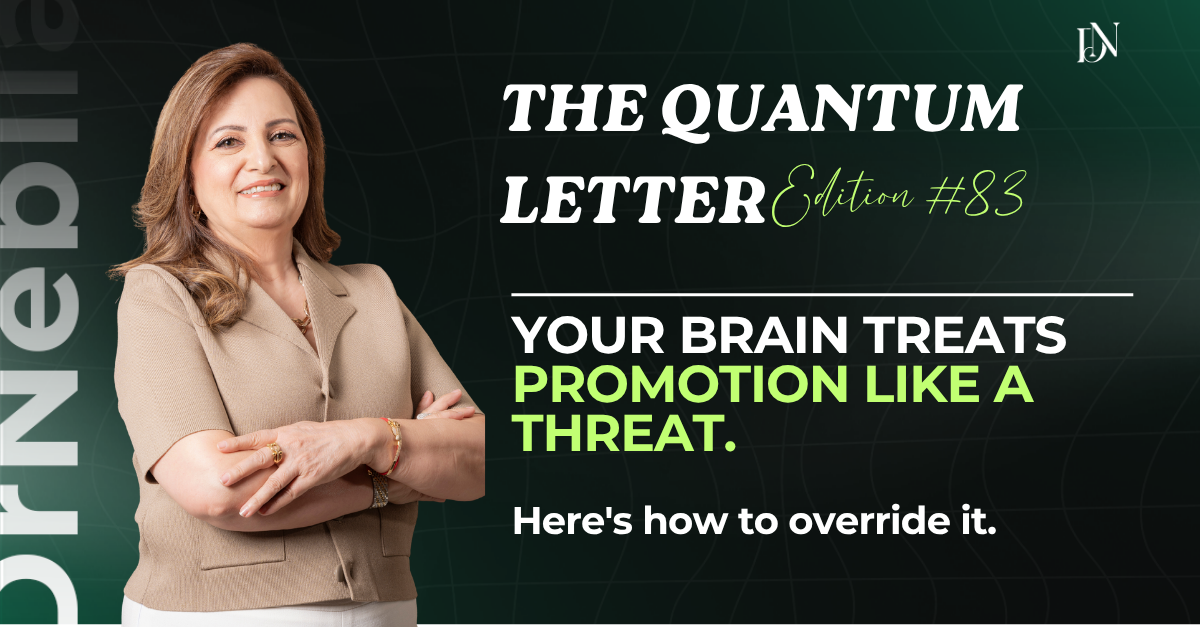
Your brain treats promotion like a threat. Here's how to override it.
Every week, I meet the same woman.
Different name. Different company. Different logo on the ID badge: Aramco, stc, a Big 4 floor in Riyadh or Dubai.
Same file.
Fifteen years of excellent work. Every certification her manager ever hinted at. A performance review that reads like a recommendation letter.
And a title that has not moved in four years.
When she sits across from me, she usually opens with the same sentence:
"I think I need one more qualification."
So I ask her the question I ask every client.
Who told you that?
Silence.
Then: "No one, exactly. It just... feels safer to be more ready."
There it is. The belief underneath the belief.
She does not think she has a positioning problem. She thinks she has a readiness problem. And readiness, conveniently, can be postponed forever.
Here is what I know after years of studying how high performers think, decide, and act under pressure. It is literally what my PhD is in:
The jump from mid-management to Director is not a bigger version of the climb that got you to mid-management.
The climb rewarded competence. The jump rewards identity.
Which means the playbook is different. And shorter than you think.
If I had to make that jump today, in a new city, with no network and no favors, I would run these seven steps and ignore everything else.
Step 1. Decide what you actually want.
Not "growth." Not "whatever opens up." A named role, a named level.
Your brain treats big career decisions as threats. It spikes cortisol and delays commitment to protect you from regret. A clean decision switches the system: it connects "who I want to be" to specific actions. People who define exactly what they want stay on track, because their choices anchor to values instead of moods.
Vague ambition feels humble. It is actually just deniable.
Step 2. Write it down. Pen, paper, today.
Not in your Notes app between meetings. On paper.
Writing converts a hazy thought into an explicit commitment and activates prospective memory, the brain's system for remembering future intentions. In the research, people who wrote their goals down were 42% more likely to achieve them than people with identical intentions who didn't.
Same ambition. One habit. Almost half again the results.
Step 3. Create a vivid mental image of you, there.
The nameplate. The meeting you now open instead of attend. The signature block.
Mental imagery runs on the same neural circuits as real performance. It is a dry run that lowers anxiety and pre-tunes your brain to recognize opportunities when they appear. Done vividly, imagined success activates reward regions almost as strongly as the real thing. The goal stops feeling foreign and starts feeling familiar.
You cannot become what your own brain classifies as "not me."
Step 4. Visualize daily. Frequency is what rewires.
Once is a daydream. Daily is neuroplasticity.
Repetition gradually overwrites the old defaults ("I'm stuck," "I'm not enough") with the image of who you are becoming. Ten to fifteen minutes a day of deliberate visualization improves performance on complex skills, because the brain learns the sequence offline, before the stakes arrive.
Step 5. Take one small action every day. No exceptions.
One message to a decision-maker. One visibility move. One sentence in the meeting you usually survive silently.
Tiny actions build the cue-routine-reward loop; repetition moves the behavior into the basal ganglia, where it becomes automatic. Small wins release dopamine, and dopamine reinforces belief. Simple behaviors take roughly 66 days to become automatic, and missing an occasional day does not derail it. Consistency beats perfection.
Step 6. Doubt your doubts, not your direction.
Doubt is not a stop sign. It is an action-crisis signal: your brain flagging the gap between where you are and where you have decided to go.
Interrogate it the way I would: Is this doubt a fact, or a belief? Is this belief true? People who question the validity of their doubts become more committed to their goals. Uncertainty, examined, strengthens identity-consistent action.
Your old identity will fight your next level. That is not a warning. That is confirmation.
Step 7. Change your inner voice. It is running the show.
That running commentary in your head narrates far more of your day than you notice. The tone of it, critical or encouraging, strongly predicts who persists.
That voice of "who you've been" is just your default mode network replaying old scripts. Replacing self-critical lines with process-oriented ones is cognitive restructuring, and it lowers anxiety and raises self-efficacy.
You would never let a colleague speak to you the way that voice does. Stop giving it a corner office.
Now look back at the seven.
Not one of them is a certification.
Not one of them requires permission, budget, or your manager's mood.
Every single one is an identity intervention, because this was never a skill problem. Hard work takes you far. Only identity takes you higher.
The woman across from me did not need to become more ready. She needed to stop negotiating with her potential.
So, one question before you close this letter:
Which of the seven have you been postponing, and what is the belief doing the postponing?
Hit reply and tell me. I read every answer.
And if you are done reading frameworks and ready to live one: this is the exact system inside my Quantum Career Accelerator™, where I work with you 1:1 to engineer your next career jump. Reply with the word QUANTUM.
That's all for this week.
See you next Tuesday.
Warmly, Nebila
----
I'm Dr. Nebila. I help accomplished women close the gap between what they've earned and being seen.
--------
Join 11,000+ senior women reading The Quantum Letter — and grab three things to start closing the gap between what you've earned and being seen:
2 Profile Tweaks: Invisible to Visible in 10 Minutes — nebiladhieb.myflodesk.com/2templates
The Visibility Identity Masterclass — nebiladhieb.myflodesk.com/masterclass
The Raise Playbook — nebiladhieb.myflodesk.com/raiseplaybook
Different name. Different company. Different logo on the ID badge: Aramco, stc, a Big 4 floor in Riyadh or Dubai.
Same file.
Fifteen years of excellent work. Every certification her manager ever hinted at. A performance review that reads like a recommendation letter.
And a title that has not moved in four years.
When she sits across from me, she usually opens with the same sentence:
"I think I need one more qualification."
So I ask her the question I ask every client.
Who told you that?
Silence.
Then: "No one, exactly. It just... feels safer to be more ready."
There it is. The belief underneath the belief.
She does not think she has a positioning problem. She thinks she has a readiness problem. And readiness, conveniently, can be postponed forever.
Here is what I know after years of studying how high performers think, decide, and act under pressure. It is literally what my PhD is in:
The jump from mid-management to Director is not a bigger version of the climb that got you to mid-management.
The climb rewarded competence. The jump rewards identity.
Which means the playbook is different. And shorter than you think.
If I had to make that jump today, in a new city, with no network and no favors, I would run these seven steps and ignore everything else.
Step 1. Decide what you actually want.
Not "growth." Not "whatever opens up." A named role, a named level.
Your brain treats big career decisions as threats. It spikes cortisol and delays commitment to protect you from regret. A clean decision switches the system: it connects "who I want to be" to specific actions. People who define exactly what they want stay on track, because their choices anchor to values instead of moods.
Vague ambition feels humble. It is actually just deniable.
Step 2. Write it down. Pen, paper, today.
Not in your Notes app between meetings. On paper.
Writing converts a hazy thought into an explicit commitment and activates prospective memory, the brain's system for remembering future intentions. In the research, people who wrote their goals down were 42% more likely to achieve them than people with identical intentions who didn't.
Same ambition. One habit. Almost half again the results.
Step 3. Create a vivid mental image of you, there.
The nameplate. The meeting you now open instead of attend. The signature block.
Mental imagery runs on the same neural circuits as real performance. It is a dry run that lowers anxiety and pre-tunes your brain to recognize opportunities when they appear. Done vividly, imagined success activates reward regions almost as strongly as the real thing. The goal stops feeling foreign and starts feeling familiar.
You cannot become what your own brain classifies as "not me."
Step 4. Visualize daily. Frequency is what rewires.
Once is a daydream. Daily is neuroplasticity.
Repetition gradually overwrites the old defaults ("I'm stuck," "I'm not enough") with the image of who you are becoming. Ten to fifteen minutes a day of deliberate visualization improves performance on complex skills, because the brain learns the sequence offline, before the stakes arrive.
Step 5. Take one small action every day. No exceptions.
One message to a decision-maker. One visibility move. One sentence in the meeting you usually survive silently.
Tiny actions build the cue-routine-reward loop; repetition moves the behavior into the basal ganglia, where it becomes automatic. Small wins release dopamine, and dopamine reinforces belief. Simple behaviors take roughly 66 days to become automatic, and missing an occasional day does not derail it. Consistency beats perfection.
Step 6. Doubt your doubts, not your direction.
Doubt is not a stop sign. It is an action-crisis signal: your brain flagging the gap between where you are and where you have decided to go.
Interrogate it the way I would: Is this doubt a fact, or a belief? Is this belief true? People who question the validity of their doubts become more committed to their goals. Uncertainty, examined, strengthens identity-consistent action.
Your old identity will fight your next level. That is not a warning. That is confirmation.
Step 7. Change your inner voice. It is running the show.
That running commentary in your head narrates far more of your day than you notice. The tone of it, critical or encouraging, strongly predicts who persists.
That voice of "who you've been" is just your default mode network replaying old scripts. Replacing self-critical lines with process-oriented ones is cognitive restructuring, and it lowers anxiety and raises self-efficacy.
You would never let a colleague speak to you the way that voice does. Stop giving it a corner office.
Now look back at the seven.
Not one of them is a certification.
Not one of them requires permission, budget, or your manager's mood.
Every single one is an identity intervention, because this was never a skill problem. Hard work takes you far. Only identity takes you higher.
The woman across from me did not need to become more ready. She needed to stop negotiating with her potential.
So, one question before you close this letter:
Which of the seven have you been postponing, and what is the belief doing the postponing?
Hit reply and tell me. I read every answer.
And if you are done reading frameworks and ready to live one: this is the exact system inside my Quantum Career Accelerator™, where I work with you 1:1 to engineer your next career jump. Reply with the word QUANTUM.
That's all for this week.
See you next Tuesday.
Warmly, Nebila
----
I'm Dr. Nebila. I help accomplished women close the gap between what they've earned and being seen.
--------
Join 11,000+ senior women reading The Quantum Letter — and grab three things to start closing the gap between what you've earned and being seen:
2 Profile Tweaks: Invisible to Visible in 10 Minutes — nebiladhieb.myflodesk.com/2templates
The Visibility Identity Masterclass — nebiladhieb.myflodesk.com/masterclass
The Raise Playbook — nebiladhieb.myflodesk.com/raiseplaybook
Leave a Reply
Your email address will not be published. Required fields are marked *
Comments (0)
Recent Posts

News
June 06, 2026
Why Read The Quantum Letters?
Articles
August 10, 2026
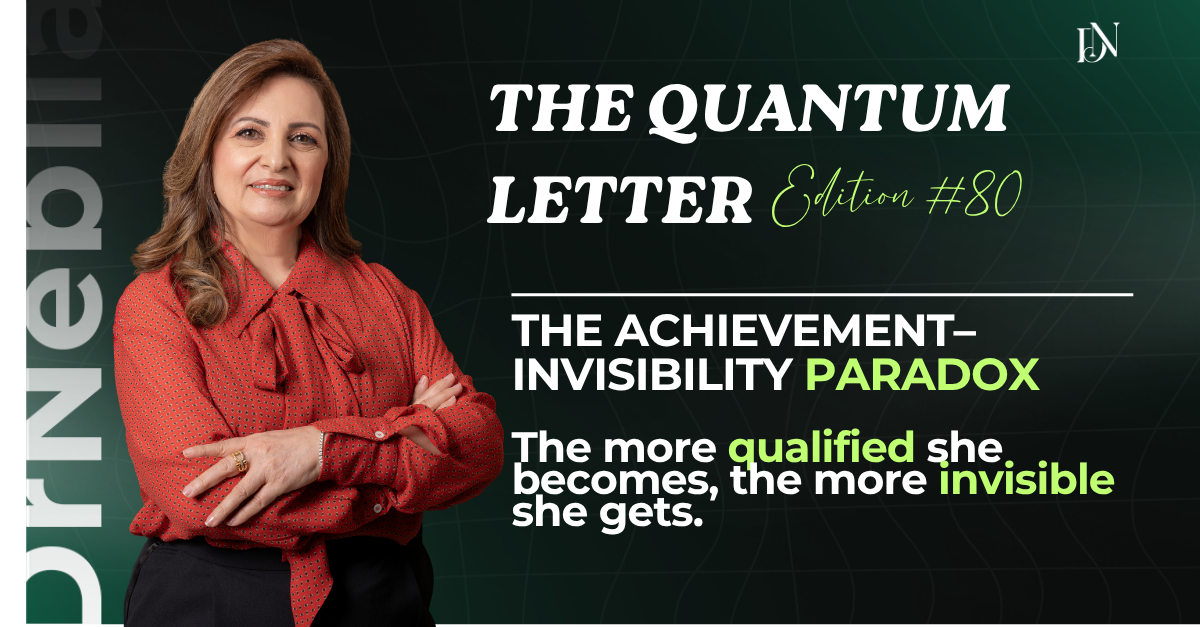
The Achievement–Invisibility Paradox

Articles
September 21, 2025
THE QUANTUM LETTER Edition No. 1
Articles
July 27, 2026
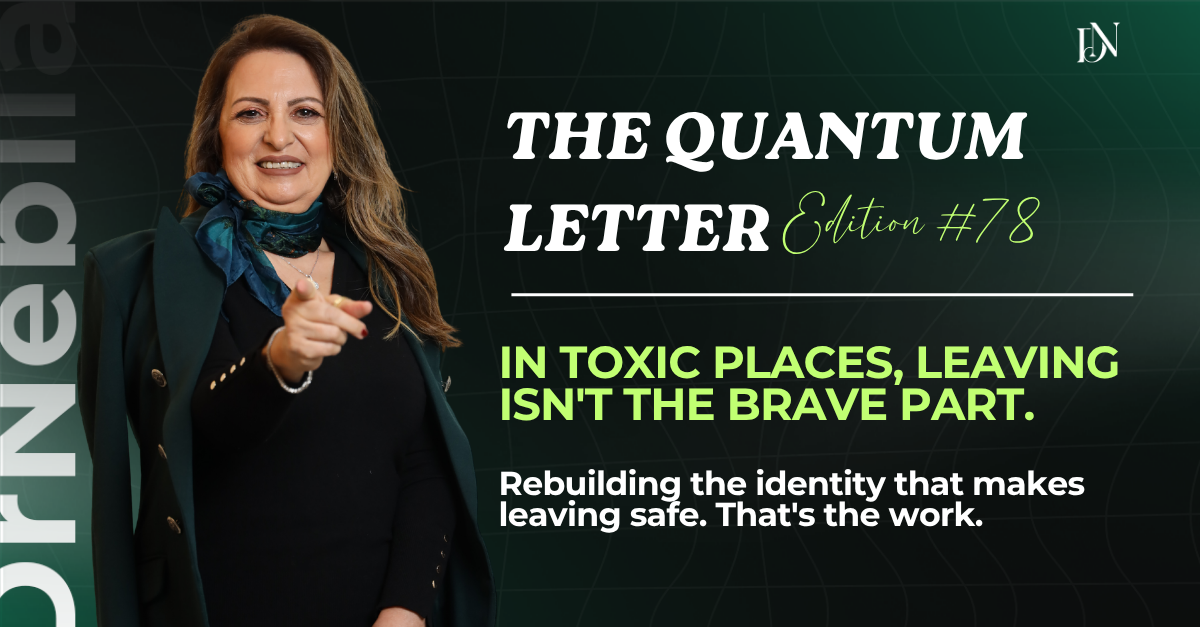
In Toxic Workplaces, Leaving Isn't the Brave Part.
Articles
August 31, 2026